
A House by the Cikeas River: The Forgotten History of Land Tapos and Its Coffee
When you hear the name Tapos today, you might immediately think of one of the districts in Depok City. Busy roads, housing developments, shops, schools, and an area that continues to grow.
But if we go back more than a hundred years, the scene would have been very different.
In the area now known as Tapos, there was once a private estate covering around 1,639 bau, or approximately 1,115 hectares. The land lay between the Sunter River and the Cikeas River and eventually became known as Land Tapos.
There were once coffee plantations, a coffee mill, settlements, and a large country house by the Cikeas River known as Landhuis Tapos.
What makes the story interesting is that Tapos was not actually the name originally used for the entire estate.
Its history began with a much longer name: Tjikempoean of Petinggi.
Before Tapos Became Tapos
One of the most interesting things about the history of Tapos is its name.
In colonial documents, the area was known as Tjikempoean of Petinggi, or with the spelling variation Tjikempoean of Petingie.
The name Tapos later appeared as an additional designation. Some documents described it as:
ook wel Tapos genaamd.
Roughly translated, this means “also known as Tapos.”
So, originally, Tapos was not the only official name used for the estate. The name Tjikempoean of Petinggi continued to appear in various records, even until the land was eventually purchased back by the Dutch colonial government in 1920.
This is interesting because it shows that place names do not always appear in a single form and simply remain unchanged.
Sometimes local names, administrative names, and names used by landowners can coexist for decades.
From Pondok Gedeh Landen to Private Estate
So how did Land Tapos come into existence?
This is actually one of the parts of the story that cannot yet be answered completely by a single document.
The travel account of Andries Teisseire from 1792 does not mention the name Tjikempoean of Petinggi. From the absence of the name, it has been suggested that the area may only have emerged as a distinct private estate after the beginning of the nineteenth century.
One important part of the context was the policy of Herman Willem Daendels.
During this period, a number of estates around Buitenzorg were divided up and sold to private parties. One of the purposes was to generate revenue for the colonial government.
According to the historical reconstruction used by the main sources, in 1809 a large estate known as Pondok Gedeh Landen was sold to Nicolaas Engelhardt. It was from this larger estate that the land later known as Tjikempoean of Petinggi emerged.
However, the identity of the first buyer of Tjikempoean of Petinggi is still not known with certainty.
This is important to keep in mind.
It does not mean that we have no information at all. In fact, there are quite a lot of pieces of information. The problem is that those pieces do not always come from a single, continuous document.
Microhistory often works like a puzzle.
A Land That Changed Hands
By the mid-nineteenth century, the Regeerings Almanak voor Nederlandsch-Indië began providing a clearer picture of the ownership of this estate.
In 1865, the owners were recorded as the heirs of the Van Riemsdijk family.
The name JM van Alken later appeared as an owner, before ownership was once again recorded under the heirs of Van Riemsdijk in 1876.
By the late nineteenth century, the Wassink family became an important part of the story of Land Tapos.
This is where things start to get a little complicated.
Not because the sources are missing, but because different sources provide genealogical details that do not always match.
The Wassink Family and a Complicated Family Tree
One version, reconstructed through local historical sources, identifies JAAH Wassink as an owner associated with Land Tapos and Land Kranggan in 1879.
Another source, which traces records through Delpher and the Regeerings Almanak, provides a different reconstruction.
According to this version, Geerlof Wassink married Catharina Johanna van Riemsdijk. Their marriage produced Egbert Geerlof Daniël Gerhardus Wassink, or EGDG Wassink.
In 1896, EGDG Wassink became the owner of Land Tapos, while his younger brother, Johannes Martinus (JM) Wassink, was recorded as the tenant.
But EGDG did not remain the owner for long.
He died on November 21, 1896, and was buried in Tanah Abang.
Land Tapos was then inherited by his wife, Catharina Gertruide van Delden.
Because their marriage produced no children, the estate eventually returned to JM Wassink around 1900.
However, another source gives different names and family relationships.
This is not a detail that should simply be hidden.
Instead, the discrepancy shows how the history of a place sometimes has to be reconstructed from separate and incomplete documents.
The same family names can appear across different generations. Names can be abbreviated. Spellings can change. And a newspaper report does not necessarily explain an entire family relationship.
So when two sources disagree, the answer is not necessarily that “one of them must be wrong.”
It is possible that both are describing different pieces of the same family history.
The Owner Was Not Necessarily the Person Managing the Estate
There is another important point when trying to understand Land Tapos: the landowner and the tenant were not necessarily the same person.
Private estates could be owned by an individual or family while their day-to-day management was entrusted to a tenant.
That is why the names of tenants also appear in various records.
At the beginning of the twentieth century, for example, different sources recorded different tenants for Land Tapos. One newspaper report mentioned Phoa Kim Tjiang, while the Regeerings Almanak listed Ong Teng Joe.
Differences like this show that the management of the estate could change over time.
So it would be misleading to imagine Land Tapos as a piece of land continuously managed by one family under an unchanged structure from beginning to end.
The relationships between owners, tenants, workers, and agricultural production were much more dynamic.
A Country House by the Cikeas River
At the center of the estate stood a building that is now one of the most fascinating parts of the story:
Landhuis Tapos.
This country house stood beside the Cikeas River, not far from Kampong Tapos.
In some documents, the building was also referred to as a heerenhuis, a Dutch term that can be understood as a large house or the residence of a landowner.
A photograph dated around 1930 is one of the most important surviving visual records of the building.
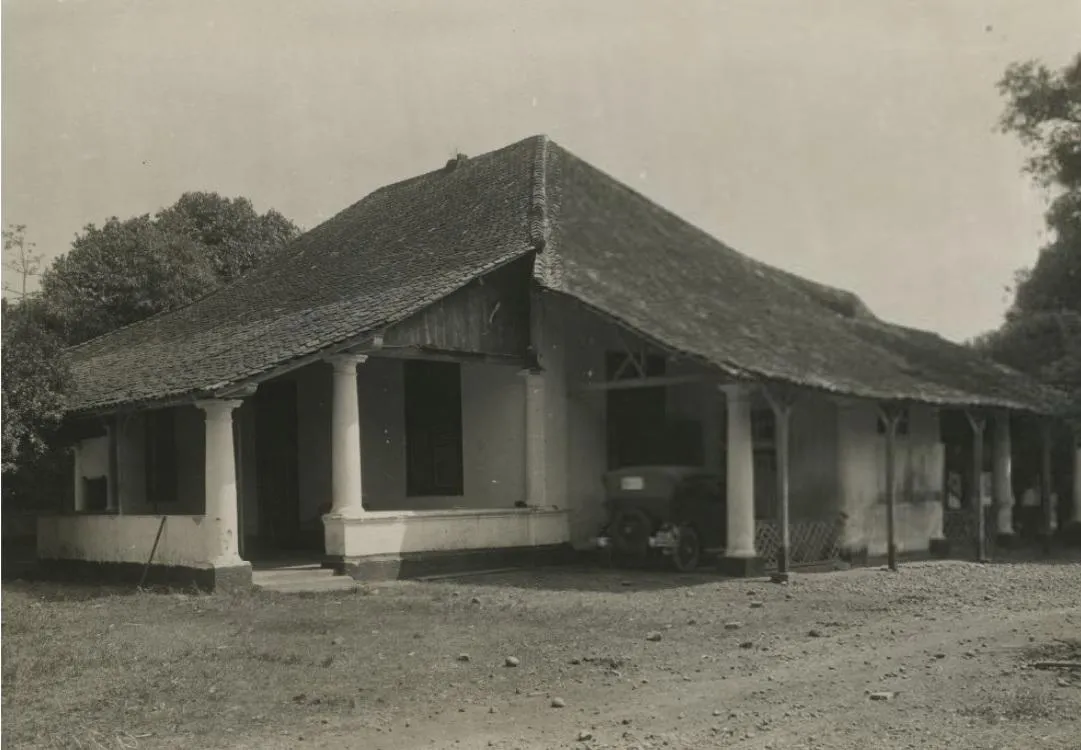
The photograph shows a single-story building in an Indisch architectural style.
The central section of the roof is high and then slopes lower toward the front. There are round white columns, a veranda, and stairs leading toward several sides of the building.
The double doors have open upper sections, presumably helping with ventilation in the tropical climate.
The building certainly looks interesting, but it should not immediately be imagined as a grand plantation palace.
Based on the available documentation, Landhuis Tapos appears to have been relatively simple and functional.
There is no visible oprijlaan, or grand entrance road, of the kind often found at larger plantation estates. Nor are there any clearly visible bell towers or large supporting buildings around the house.
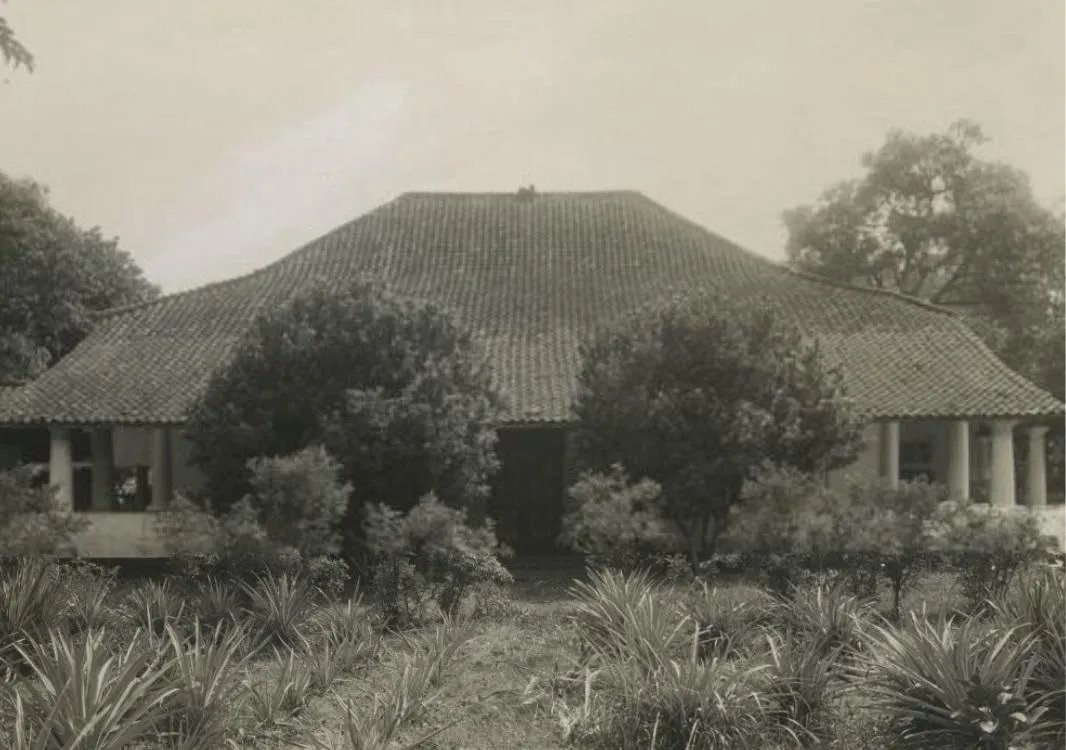
Because of this, it is reasonable to suggest that the house functioned mainly as a residence or stopping place for the owner or tenant while they were staying on the estate.
More Interesting Still: Tapos Had Coffee
This is where the story of Land Tapos connects with the history of coffee.
According to the Regeerings Almanak, coffee had already been cultivated in the area since the first half of the nineteenth century.
The coffee plants then disappeared from the records for several decades.
Around the turn of the century, coffee once again became the main commodity of Land Tapos and was recorded as such until around 1918.
So coffee was not merely a side crop.
During certain periods, coffee became an important part of the estate’s economic activity.
And there is one piece of evidence that makes the story even more interesting.
A 1901 map of Tapos shows the presence of a koffiepelmolen.
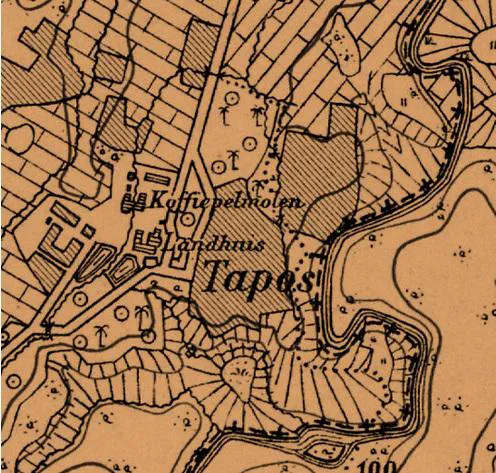
Simply put, it was a coffee-processing or coffee-milling facility.
It was located not far from Landhuis Tapos.
That means Land Tapos was not merely a place where coffee was grown.
There was also a facility for processing the harvest.
How Much Coffee Was There?
Buitenzorg statistics from 1861 provide an interesting glimpse into the scale of coffee cultivation.
In the area that would later become known as Land Tapos, around:
11,567 coffee trees that had not yet begun producing.
We can compare that number with neighboring estates.
Land Tjilangkap: around 1,450 trees.
Land Tjimanggis: around 24,987 trees.
So Tapos was not the largest coffee estate.
Tjimanggis had far more coffee trees.
But Tapos had something interesting:
its own coffee-milling facility.
And it is precisely this facility that makes the history of Tapos coffee worth exploring.
Tapos Coffee in the History of Buitenzorg Coffee
Tapos did not exist in isolation.
The area was part of Buitenzorg, the name used by the colonial government for Bogor and its surrounding region.
Coffee itself had a long history in Buitenzorg.
Local historical sources tracing the development of coffee in the region show that coffee cultivation in Buitenzorg had already developed long before modern coffee plantations emerged on a large scale.
Tapos became one small part of this wider coffee plantation network.
But Tapos coffee never became as famous as Preanger coffee.
Coffee from the Priangan region developed on a much larger scale and became an important part of the export trade.
Meanwhile, coffee estates in Buitenzorg, including private estates such as Tapos, generally operated on a smaller scale.
So it is hardly surprising that the name of Tapos coffee eventually disappeared from public memory.
The coffee was there.
The plantation was there.
The mill was there too.
But it did not leave behind a brand name that survived into the present.
Tapos and the Cultivation System
There is another historical context worth considering.
When we talk about coffee during the colonial period, we often immediately connect it with the Cultivation System, or Cultuurstelsel, which began in 1830.
But Land Tapos needs to be placed in a slightly different context.
It was a private estate.
This means that the management and production of coffee there cannot simply be equated with government coffee plantations operating under the Cultivation System.
Coffee production on private estates was shaped by economic relationships between landowners, tenants, and the workers who managed the plantations.
In other words, the history of Tapos coffee is also a history of private plantation agriculture.
This matters because it makes the history of coffee in Java much more complicated than simply saying, “The Dutch forced farmers to grow coffee.”
Different systems of land ownership and agricultural management existed side by side.
1920: The End of Land Tapos as a Private Estate
After passing through various owners and tenants, the private-estate chapter of Land Tapos finally came to an end in 1920.
The Dutch colonial government bought the land back.
Its status changed to landsdomein, or state land.
This marked the end of a long period in which the area had operated under a private landownership system.
Three years later, JM Wassink died and was buried in Tanah Abang.
In 1932, Catharina Gertruide van Delden died in Nice, France.
Meanwhile, Landhuis Tapos continued to appear in records and photographs until around the 1930s.
After that, its traces became increasingly difficult to follow.
What Happened to Landhuis Tapos?
This may be the saddest part of the story.
The house that once stood at the center of an estate covering more than a thousand hectares is now almost completely forgotten.
Photographs still exist.
Old maps still exist.
The name Tapos still exists too.
But the building itself is no longer part of the landscape familiar to people today.
Local historical research into Tapos also suggests that the exact location of Landhuis Tapos eventually became increasingly difficult to identify.
The house disappeared from view.
The plantation disappeared.
The coffee mill disappeared too.
But the name Tapos survived.
From Coffee Estate to District Name
This may be the most fascinating part of the entire story.
The name that once appeared merely as an additional designation—ook wel Tapos genaamd—eventually became far more familiar than the original official name.
Tjikempoean of Petinggi gradually faded away.
Tapos survived.
Throughout the twentieth century, the name Tapos continued to appear on maps and in regional records. As Depok later developed administratively, the area underwent further changes in status.
In 2007, Cimanggis District was divided, and one of the newly established districts was given the name Tapos.
In this way, a name once associated with a private estate and coffee plantation eventually became an administrative name that is still used today.
A Lost History, a Surviving Name
When you think about it, the story of Land Tapos is actually quite remarkable.
In a place that is now part of urban Depok, there was once an estate covering more than 1,100 hectares.
There were owners and tenants who came and went.
There was the Van Riemsdijk family.
There was the Wassink family.
There was a large country house beside the Cikeas River.
There was a coffee plantation.
There were thousands of coffee trees.
There was even a koffiepelmolen, a coffee mill.
And then, slowly, it all disappeared.
Not simply because the buildings collapsed.
But because the function of the land changed, the ownership system changed, and the city eventually grew over the old landscape.
What survived was something much simpler:
a name.
Tapos.
And perhaps this is what makes local history so fascinating.
We often assume that the name of a district, village, or street simply appeared out of nowhere.
But behind a single name there can be a story about land, inheritance, plantations, trade, rivers, families, and shifting power that unfolded over more than a century.
Tapos is one of those stories.
Today, we may pass through the area without ever knowing that a large country house once stood beside the Cikeas River.
Coffee once grew around it.
And not far from the house, there once stood a modest building with a name that now sounds almost unfamiliar:
koffiepelmolen.
A coffee mill.
A small surviving trace of Depok’s almost-forgotten coffee history.
Methodological Note and Sources
This article is based on the sources provided, particularly Teguh Setiawan’s article in REQnews about Landhuis Tapos and the story of its final landholding families, as well as Akhir Matua Harahap’s writings at Poestaha Depok on the history of Tapos, Cilangkap, Cimpaeun, and the development of coffee in Buitenzorg.
These sources draw upon and trace a range of colonial primary records, including the Regeerings Almanak voor Nederlandsch-Indië, Statistik Buitenzorg, Bevolkingstatistiek van Java, as well as newspapers such as the Bataviaasch nieuwsblad, Java-bode, De Telegraaf, and Soerabaijasch handelsblad through the Delpher digital archives.
Because some of the information is reconstructed from multiple documents, there are differences between sources, particularly concerning the Wassink family genealogy, the names of owners, and the sequence of inheritance. These differences have deliberately been preserved in this article rather than being simplified into a single version as though it were definitively established.
In other words, this article does not treat every detail as an established fact. Some sections are historical reconstructions based on the available archival evidence, while certain causal relationships remain interpretations by researchers.
And that is precisely what makes the history of Tapos so interesting: we are not reading a single story that has already been completely written, but reconstructing a place from the fragments of documents that have survived.
References
Harahap, A. M. (2017, July). Sejarah Kota Depok (20): Sejarah Tapos, Cilangkap dan Cimpaeun. Poestaha Depok. http://poestahadepok.blogspot.com/2017/07/sejarah-kota-depok-20-sejarah-tapos.html
Harahap, A. M. (2017, January). Sejarah Bogor (2): Kopi Buitenzorg, lebih tua dari kopi Preanger. Poestaha Depok. http://poestahadepok.blogspot.com/2017/01/sejarah-bogor-2-kopi-buitenzorg-lebih.html
Harahap, A. M. (2020, May). Sejarah Bogor (63): Kopi Land Buitenzorg, sentra tidak hanya di Megamendung dan Cibungbulang. Poestaha Depok. http://poestahadepok.blogspot.com/2020/05/sejarah-bogor-63-kopi-land-buitenzorg.html
Pradadimara. (n.d.). Coffee economy in late colonial Netherlands East Indies: Estates and capital, 1890–1940. Lembaran Sejarah, Universitas Gadjah Mada. https://jurnal.ugm.ac.id/lembaran-sejarah/article/view/33509
Setiawan, T. (2025, April 22). Landhuis Tapos dan kisah dua keluarga landheer terakhir. REQnews. https://www.reqnews.com/read/memoar/86036/landhuis-tapos-dan-kisah-dua-keluarga-landheer-terakhir
Setyanto, J. (2020, May 31). Moksanya Landhuis Tapos yang bertaji di Depok. Kompasiana. https://www.kompasiana.com/juliansetyanto/5ed3d724097f3657e738bf92/moksanya-landhuis-tapos-yang-bertaji-di-depok
Nuansa Depok. (2018, August). Asal usul Kecamatan Tapos Depok. https://nuansadepok.blogspot.com/2018/08/asal-usul-kecamatan-tapos-depok.html

